

Supergrow.ai Review: Worth $39/month?

TL;DR
Is Supergrow worth $39 a month? For me, no. It's a well-built LinkedIn tool, and its Kanban board, calendar and viral post search are genuinely good. But it suits people who'd rather talk than type and don't mind putting in the time. It asked for too much work for ₹3,460 a month (the Indian price), so I cancelled the same day.
Now the long version.
Signing up
Supergrow asked what describes me best (creator, team or agency), then my name and email.
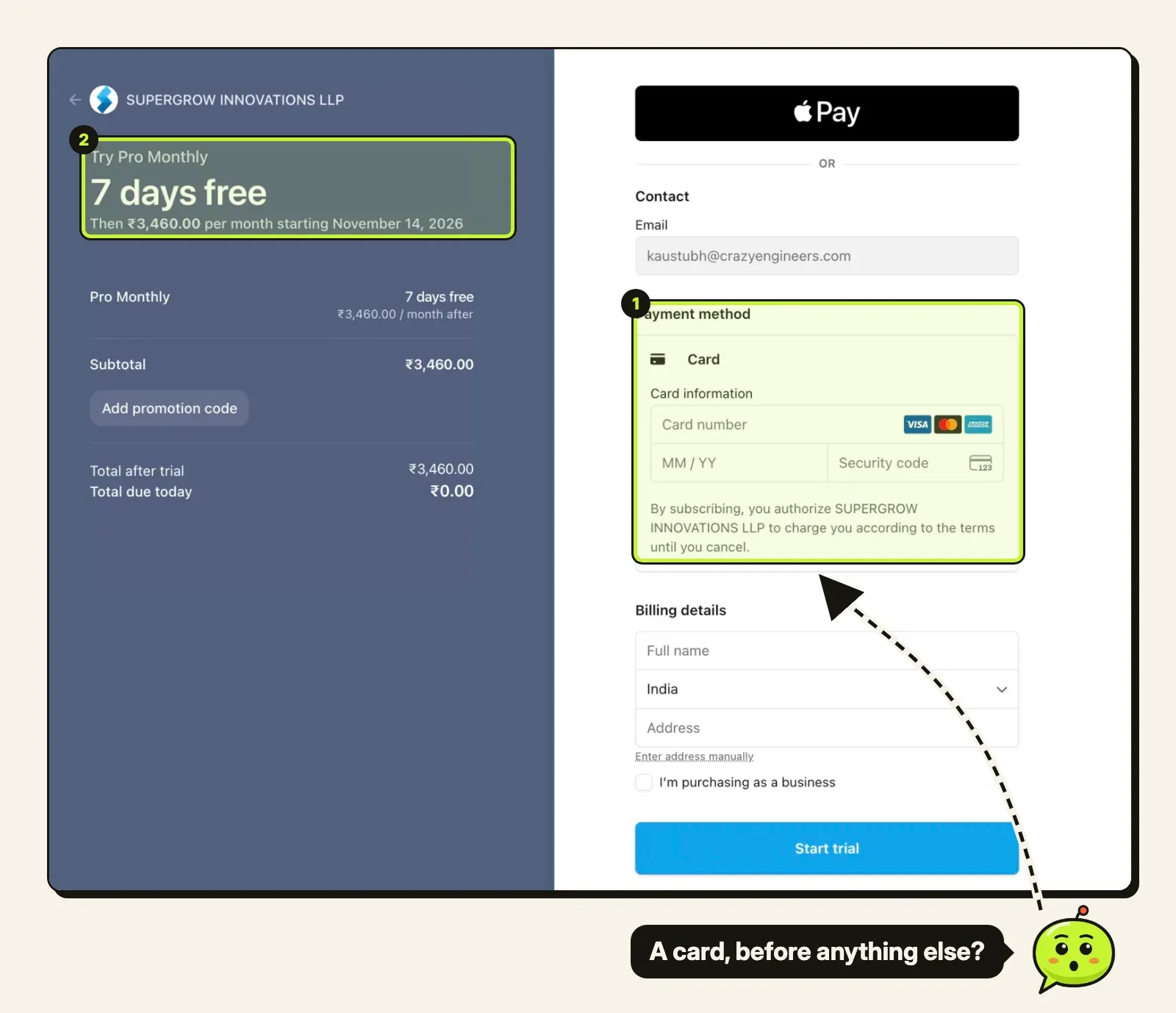
Then came a checkout. "Try Pro Monthly, 7 days free, then ₹3,460 per month." Card number, expiry, billing address. Nothing to pay today, but I couldn't create anything until I'd added a card.
Their pricing page doesn't mention this. It says "7-day free trial, no commitment", so I wasn't expecting it. I added my card anyway, because I wanted to see the product.
The dashboard
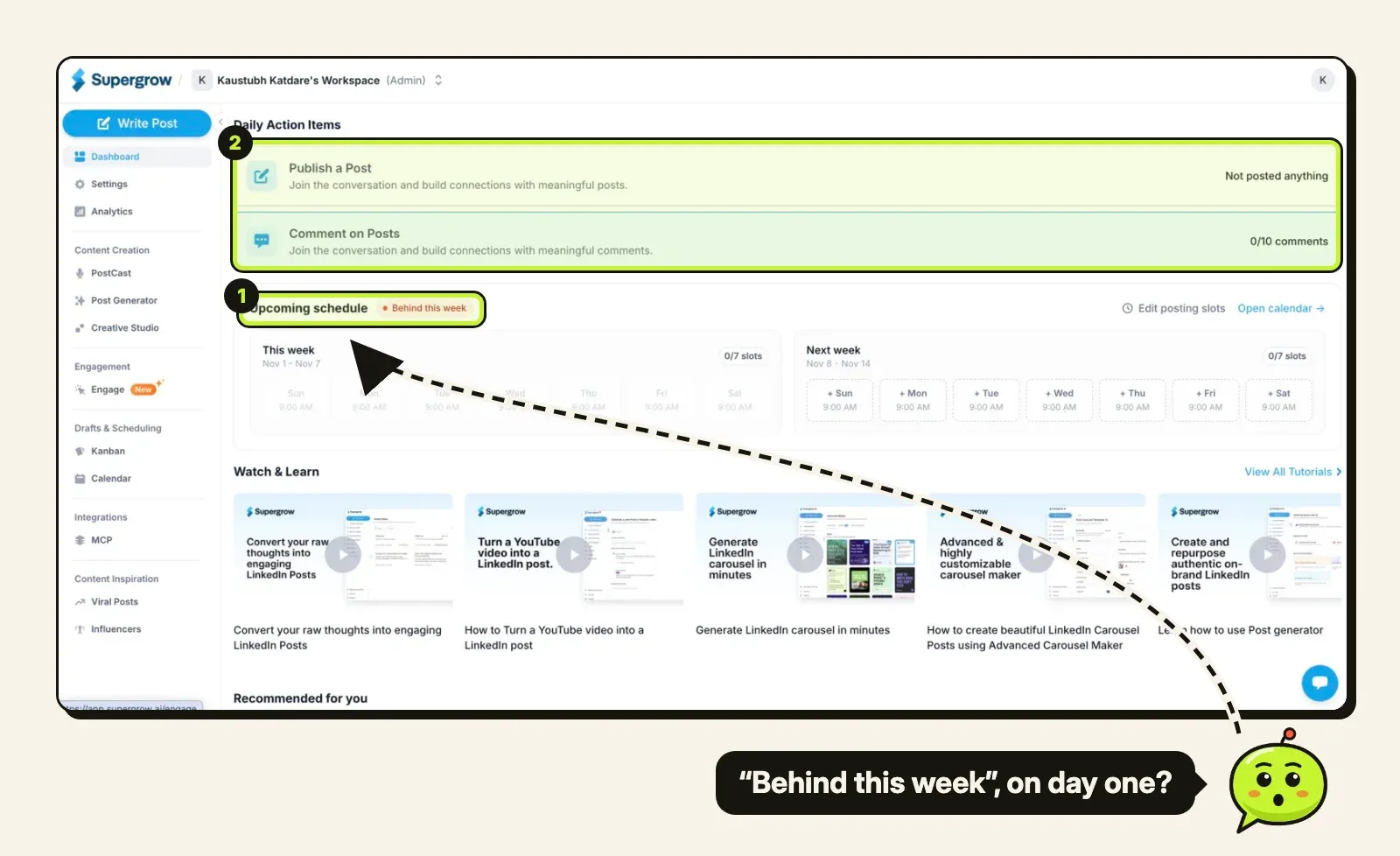
The first screen after sign-up confused me. Daily action items (publish a post, comment on 10 posts), a weekly schedule, tutorial videos and a sidebar with 14 items.
And in red, a label: "Behind this week". I had signed up a few minutes earlier.
I just kept looking at it for some time. Then I clicked Write Post.
My one-line idea
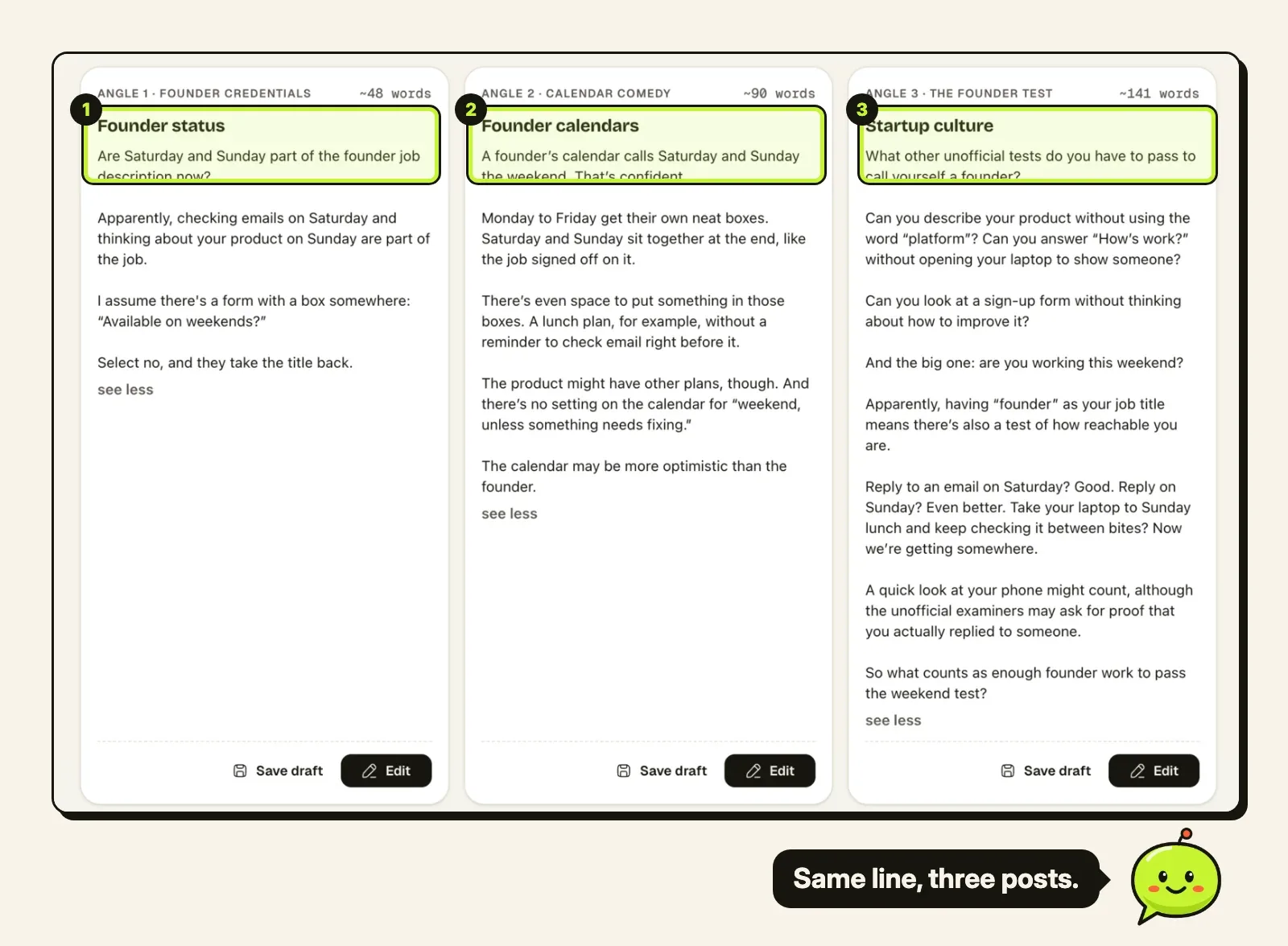
I gave it an idea I'd been thinking about: "If you are not working on weekends, do you even qualify to call yourself a founder?"
I picked Write Manually, typed the line and pressed the AI button. A spinner went round for about 20 seconds. I gave up and refreshed the page. When I tried again, it said: "Failed to rewrite. Please select some text before clicking the button."
So I selected the line and tried Format Post. Nothing changed. Then Improve Structure. Nothing again.
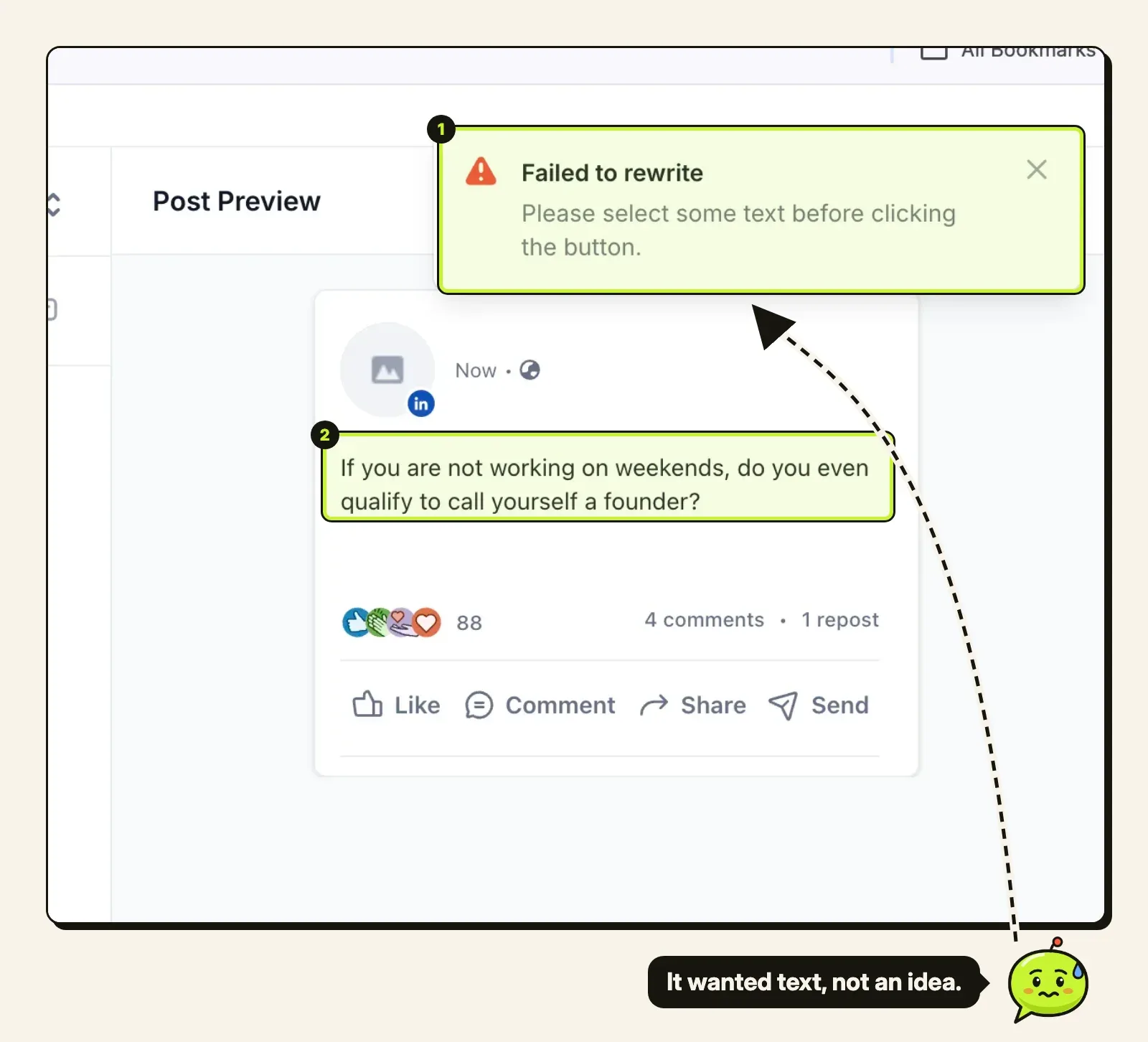
That's when it clicked for me. Supergrow's AI reworks text you already have. It doesn't write a post from a thought. If you want to try that with any idea of yours, our free LinkedIn post generator does exactly that.
I gave the same line to Wiral, and Wiri came back with three posts. I've put both side by side on the Supergrow vs Wiral.Social page, along with my screenshots.
PostCast, the AI interview
Supergrow's main way of writing is PostCast. An AI interviewer called Alex asks you questions and turns your answers into posts.
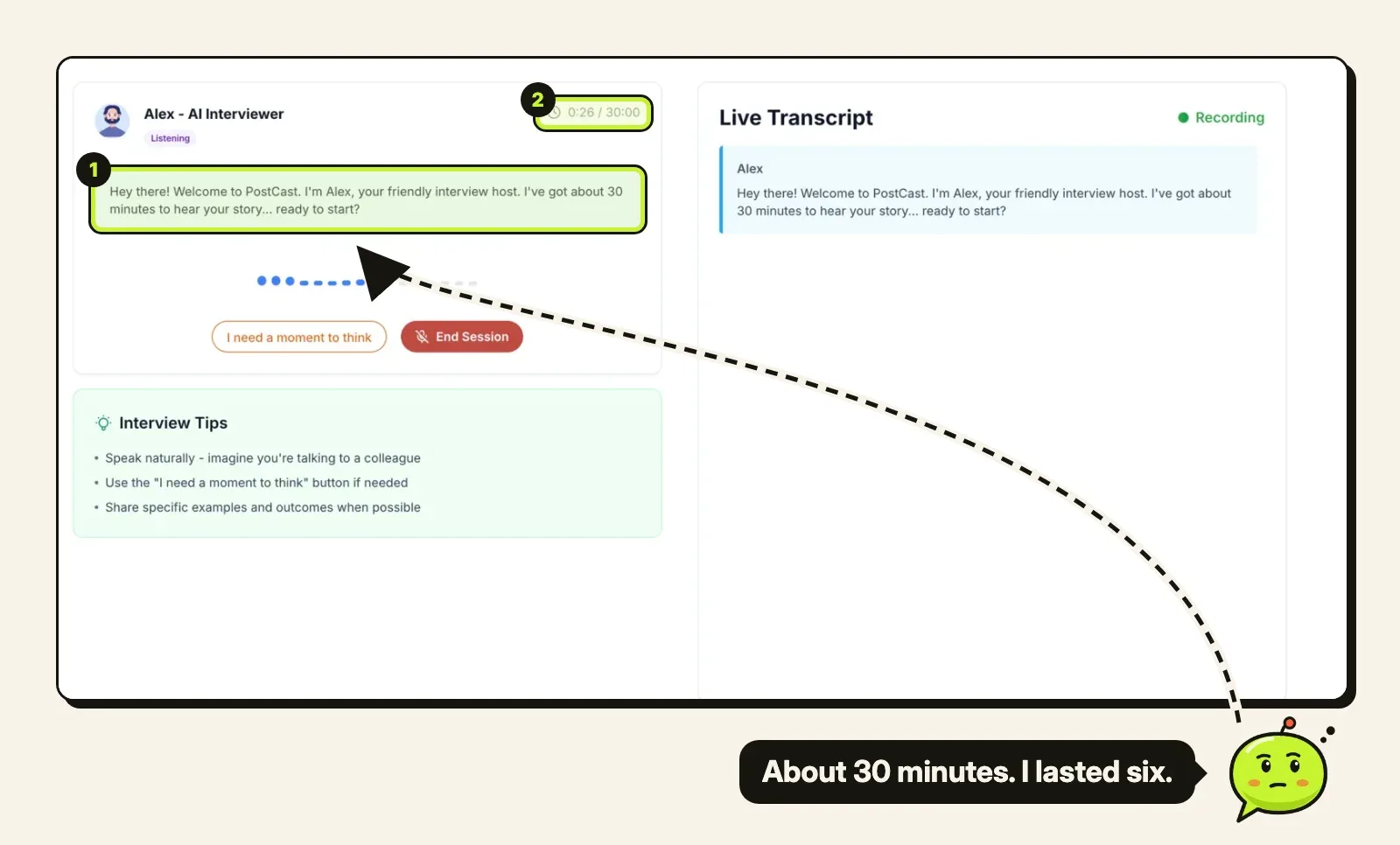
The intro screen said "Have a 30-minute chat with Alex". Their website says 10 to 15 minutes. I picked voice only (I'm not comfortable being on camera with an AI) and my own topic: startup lessons.
It took about a minute to get ready. Then Alex said: "I've got about 30 minutes to hear your story… ready to start?" The clock on the screen counted up to 30:00.
The first question was good: "What's the one startup lesson that completely blindsided you the first time around?" I talked about building features nobody asked for, and why I now think the first 90 days should be 80% marketing and 20% building.
After that, the questions got abstract and kept circling the same topic. Twice I said, "I don't know how to answer that." I got bored at about six minutes and ended the session. It could be just me. Some people love talking things out.
One more thing felt strange. Supergrow had asked for my LinkedIn profile link during sign-up, but Alex didn't seem to know anything about me.
The part I liked
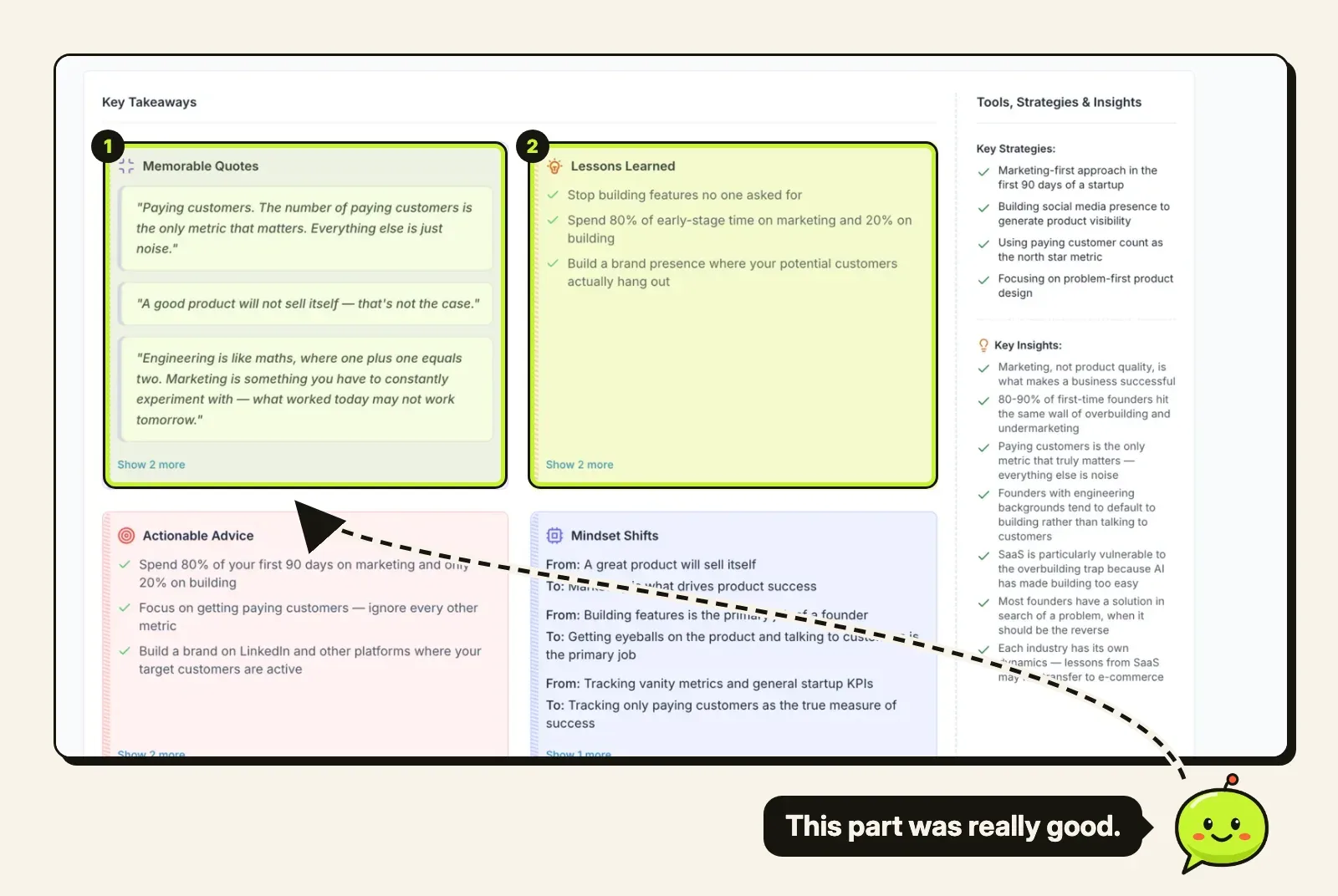
After the interview, Supergrow made "Key Takeaways": memorable quotes, lessons learned, actionable advice and mindset shifts. It kept my own words. "Paying customers is the only metric that matters. Everything else is just noise."
This was really good. Six minutes of rambling, turned into a neat summary.
The posts it wrote
From those six minutes, it wrote three posts, all on startup lessons. Here's the first one, exactly as it came out:
Building features nobody asked for kills startups.
I know because I did exactly that.
I spent months deep in product development, convinced that if I just built something great, people would find it. That was the plan. Build something excellent. Watch it grow.
It didn't grow.
What it did was drain my time and money on features nobody expected, nobody requested, and honestly, nobody cared about.
The shift happened when I stopped building and started talking. Started getting eyeballs on the product. Started showing up where potential customers actually hang out. LinkedIn. Social media. Conversations.
That's when calls started getting booked.
Here's what I wish someone had told me on day one: your first 90 days should be 80% marketing, 20% building. Not the other way around.
Most of us come from engineering backgrounds. Engineering is like maths — one plus one equals two. Something either works or it doesn't. Clean. Logical. Certain.
Marketing is the opposite. You experiment constantly. What works today may not work tomorrow. That uncertainty is uncomfortable for people wired to build things.
But getting uncomfortable with marketing is the job.
80 to 90% of first-time founders hit this exact wall. I was one of them. The realization was surprising. The cost was real. And the pivot — from builder to marketer — is what actually moved the needle.
Did you make the same mistake early on, or did someone warn you in time?
It read well. But it was inspired by what I said, not quite what I said. Parts of the story were made up, and the writing didn't sound like me. I wouldn't post it without rewriting it.
There's a reason all three were on one topic: the interview was on one topic. That works for a week. But if you post often (I shared what I learned in my 4-month posting experiment), one topic runs dry fast. You need variety within what you do. I wrote about how I think about this in my LinkedIn content strategy for 2027.
I should be fair here: I skipped Content DNA, the setting where Supergrow learns your style from your old posts. With it, the posts might sound more like me.
Editing the post
The editor is basic. You get a preview for phone, tablet and desktop, and buttons to save, schedule or publish.
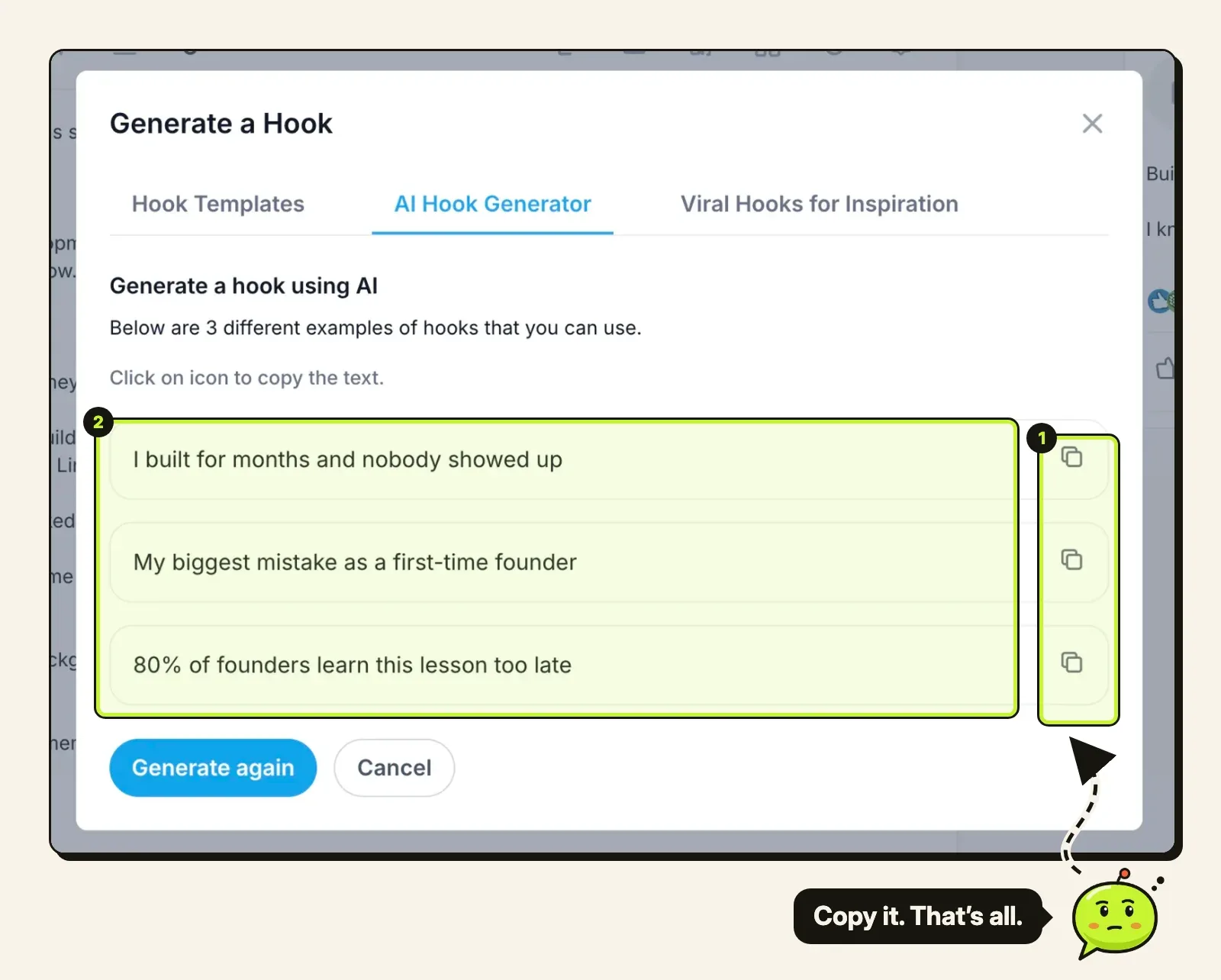
The hook button opens three tabs: hook templates, an AI hook generator and viral hooks. The templates are fill-in-the-blank lines like "Never be (Unwanted Feeling)". The AI gave me three hooks, and none of them fit. Each one has a copy button, and that's all. The post isn't rewritten around the hook you pick, so you're rebuilding it yourself.
If you want to see how your opening line shows up before "…more", our free hook checker scores it and shows you the cut-off.
Then I tried a custom instruction: "Make it shorter and more punchier. Add some humor as well."
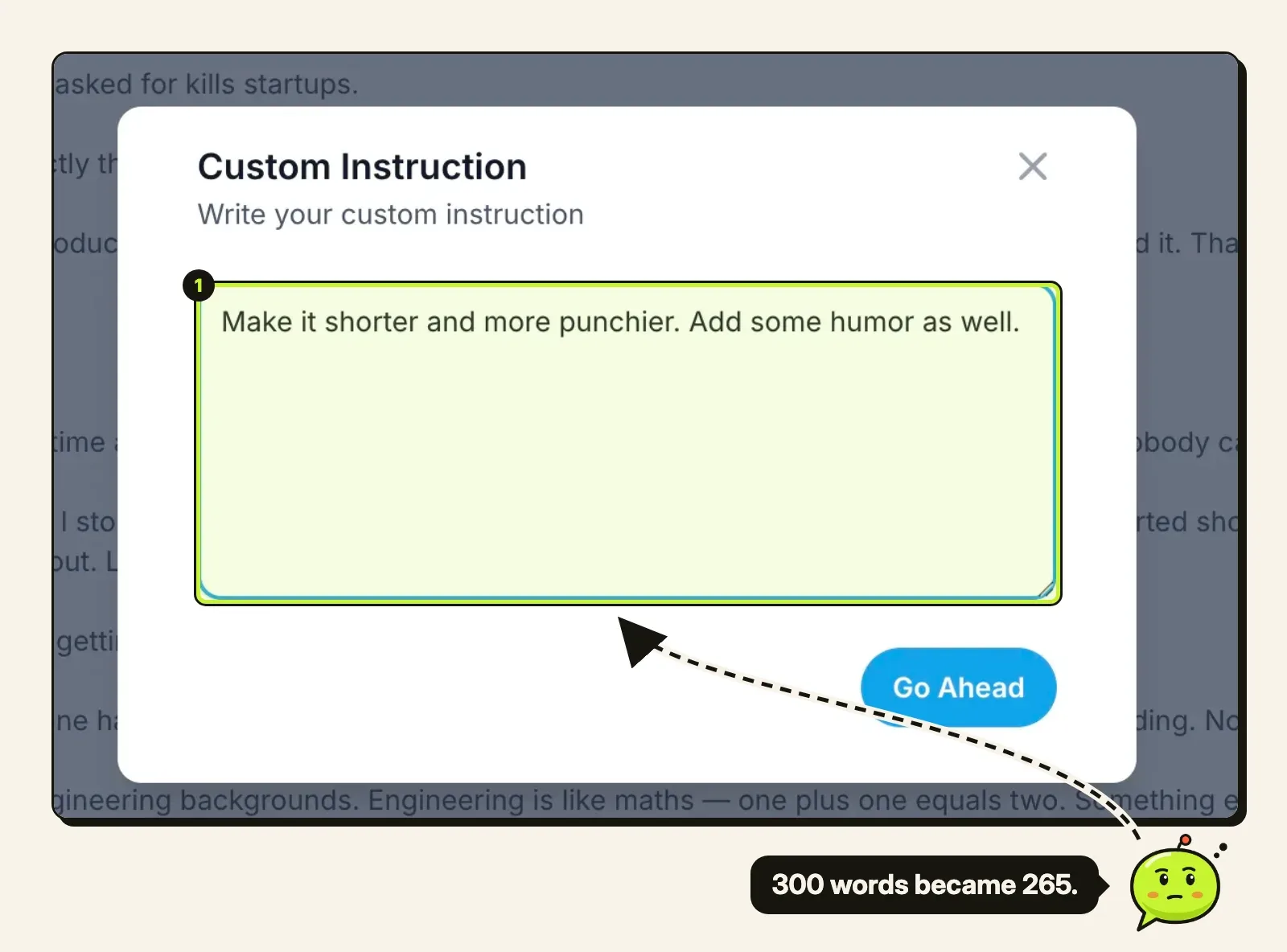
Here's what came back:
Building features nobody asked for kills startups. I know because I did exactly that.
I spent months heads-down in product development, convinced that "build it and they will come" was a strategy. Spoiler: it wasn't.
The result? A beautifully crafted product that drained my time and money — and that nobody cared about.
The shift happened when I stopped building and started talking. Showing up on LinkedIn. Having real conversations. Getting eyeballs on the product where customers actually hang out.
That's when the calls started coming in.
Here's what I wish someone had slapped me with on day one: your first 90 days should be 80% marketing, 20% building. Not the other way around.
Most founders come from engineering backgrounds. Engineering is clean, logical, satisfying — one plus one equals two. Marketing is the opposite. It's messy, unpredictable, and constantly changing. For builder-brained people, that uncertainty is deeply uncomfortable.
Too bad. Getting comfortable with uncomfortable is the job.
80 to 90% of first-time founders hit this exact wall. I was one of them. The pivot — from builder to marketer — is what actually moved the needle.
Did you figure this out the hard way, or did someone warn you just in time?
It went from about 300 words to 265. The humour was "Spoiler: it wasn't" and "Too bad." Not much shorter, and not much funnier.
One more try: the post generator
Supergrow also has a Post Generator. You give it a topic and a tip, and it writes a post. I gave it "community building" and one line I believe in: "Social media following is not your community."
It also asked me to pick a content style. I clicked Add New to make one, and the page that opened stayed white. So I generated without one.
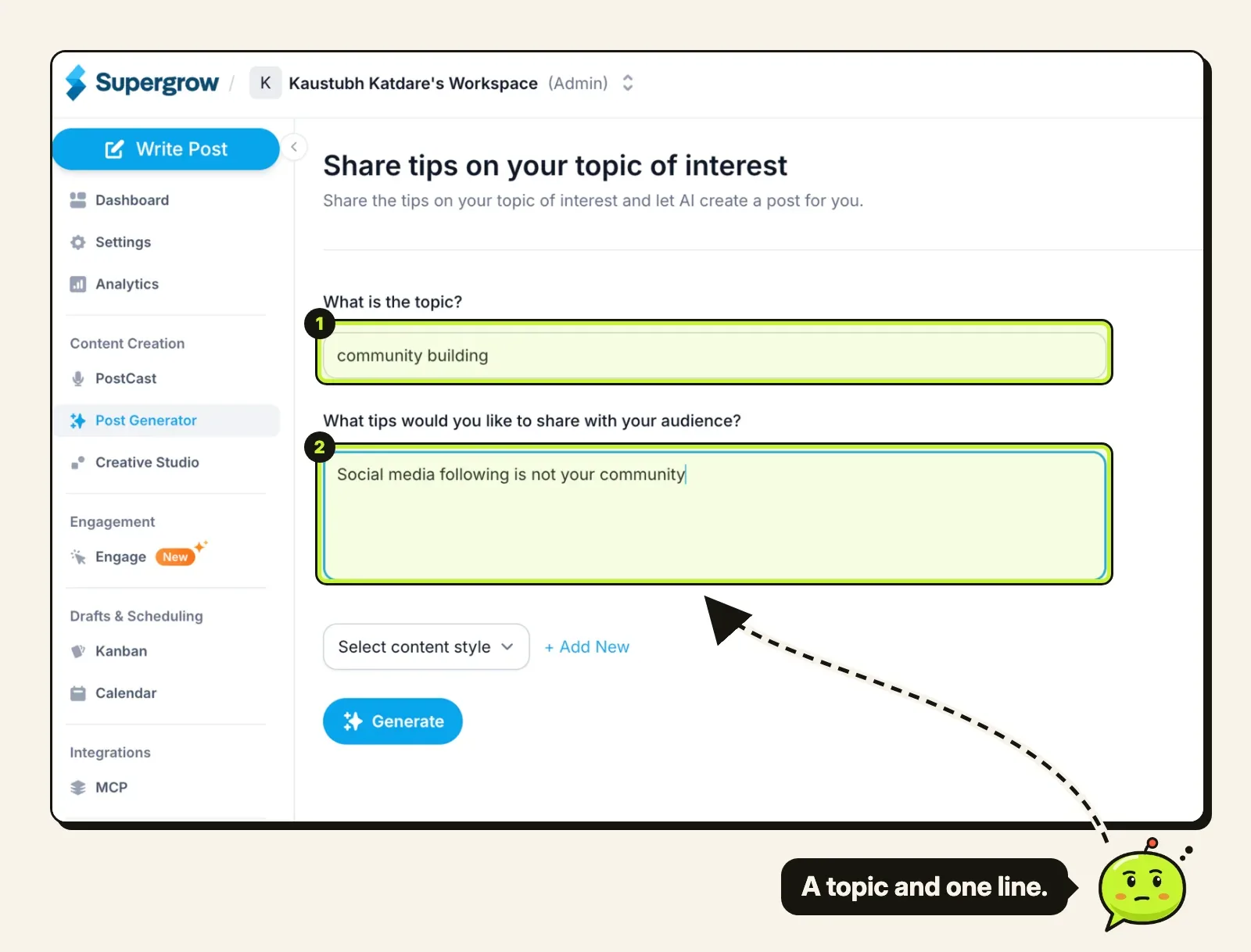
This is what it wrote:
Your social media following is not your community.
I see this mistake everywhere.
Founders celebrate hitting 10K followers on LinkedIn or Instagram, then wonder why nobody buys when they launch something.
Here's the hard truth:
A follower is someone who clicked a button. A community member is someone who shows up.
There's a massive difference between the two.
Your followers scroll past your content between cat videos and job announcements. Your community actively looks for what you're saying next.
Your followers consume. Your community contributes.
Your followers disappear when the algorithm stops favoring you. Your community finds you anyway.
So how do you build an actual community?
→ Create a space you own. A newsletter, a Discord, a Slack group, a private forum. Something that isn't at the mercy of a platform's algorithm.
→ Start conversations, don't just broadcast. Real communities are built on dialogue, not monologues.
→ Recognize your people. Call out members by name. Celebrate their wins. Make them feel seen.
→ Have a shared identity. The strongest communities form around a belief, a mission, or a problem — not just a person.
→ Show up consistently, even when it's quiet. Trust is built in the slow seasons.
The goal isn't to collect followers.
The goal is to build a group of people who genuinely care about what you're building — and who you genuinely care about in return.
That's the foundation everything else grows from.
Are you building a following or a community? Be honest with yourself.
It's tidy, and the advice isn't wrong. But there's nothing of me in it. No story, nothing from my 20 years of building communities. Anyone could have posted it.
Carousels
The carousel maker has a nice set of templates, and you can edit text right on the slide.
I picked one called Midnight Lavender. It showed a sample name, "Jon Snow", with a stock photo. I expected my own name and photo, since I'm the one posting. When I exported it, it still said Jon Snow. That's my fault for not changing it, but I'd have liked it filled in for me. The five-slide PDF came to 20.9 MB.
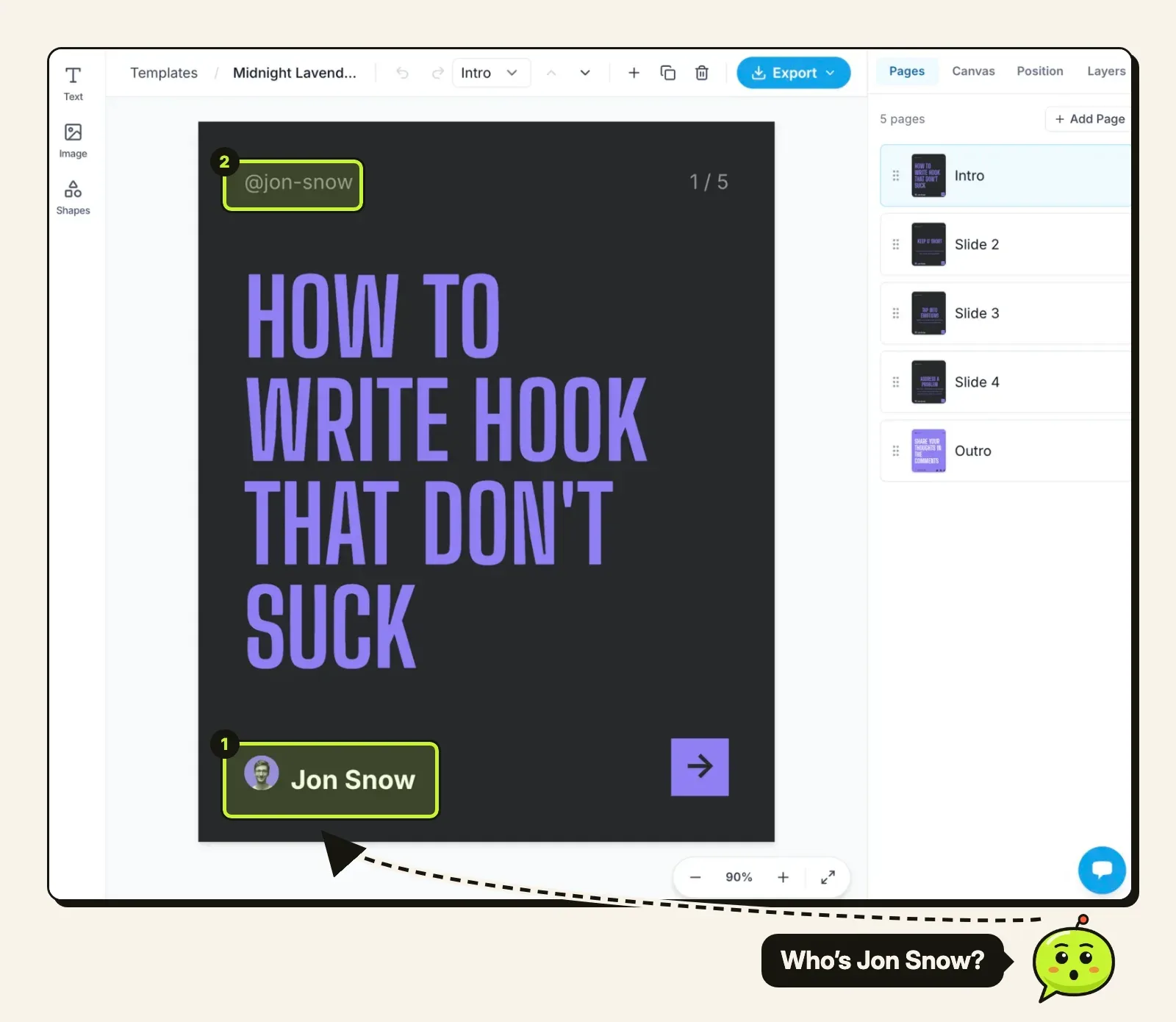
If you just want to try making one, our free carousel maker runs in your browser.
What Supergrow does well
I want to be clear that this isn't all bad.
The Kanban board is genuinely useful. Every post sits in a column, from Drafts to In Review, Approved, Scheduled and Published. For a team with approvals, that's exactly what you want.
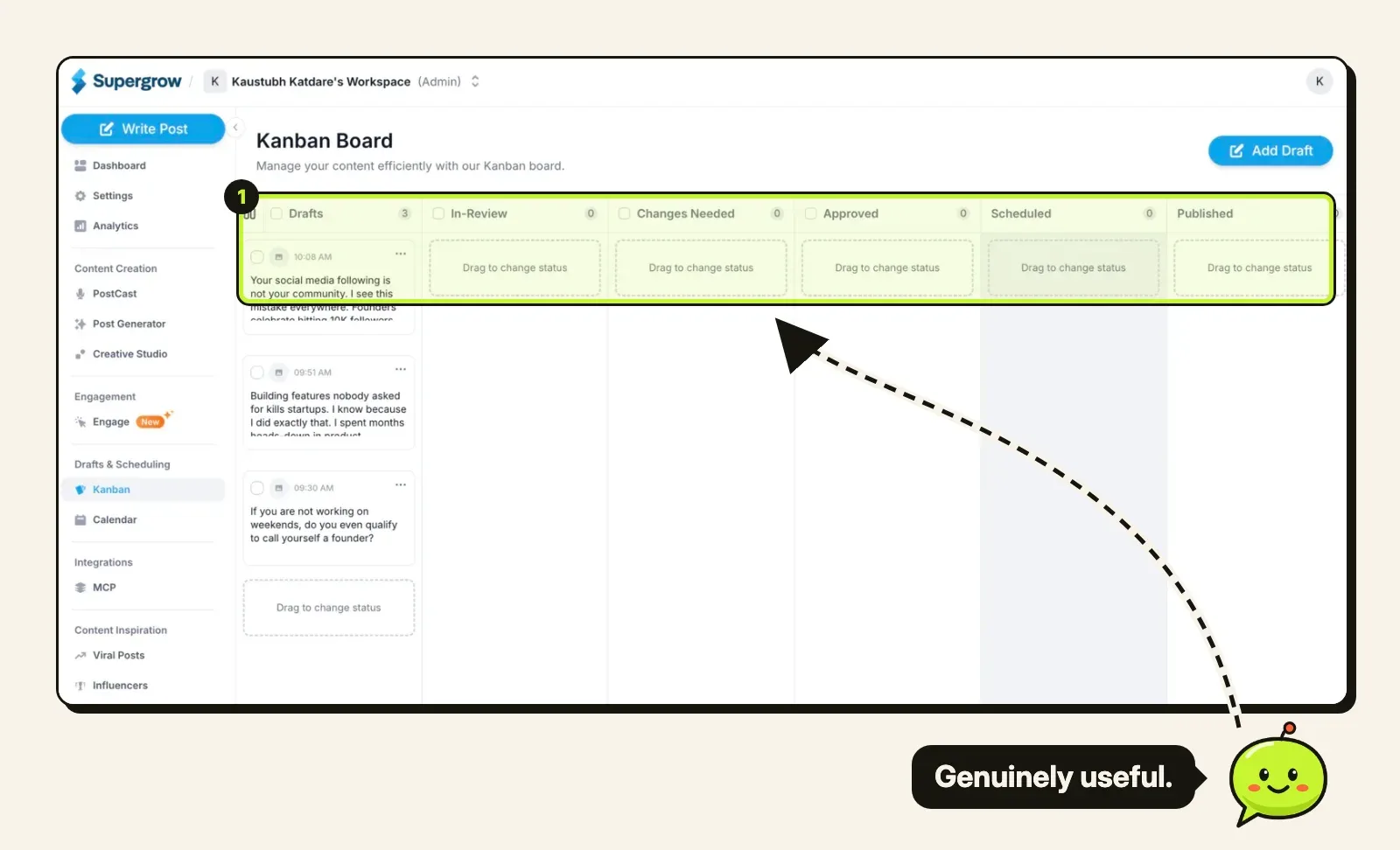
The calendar is well done.
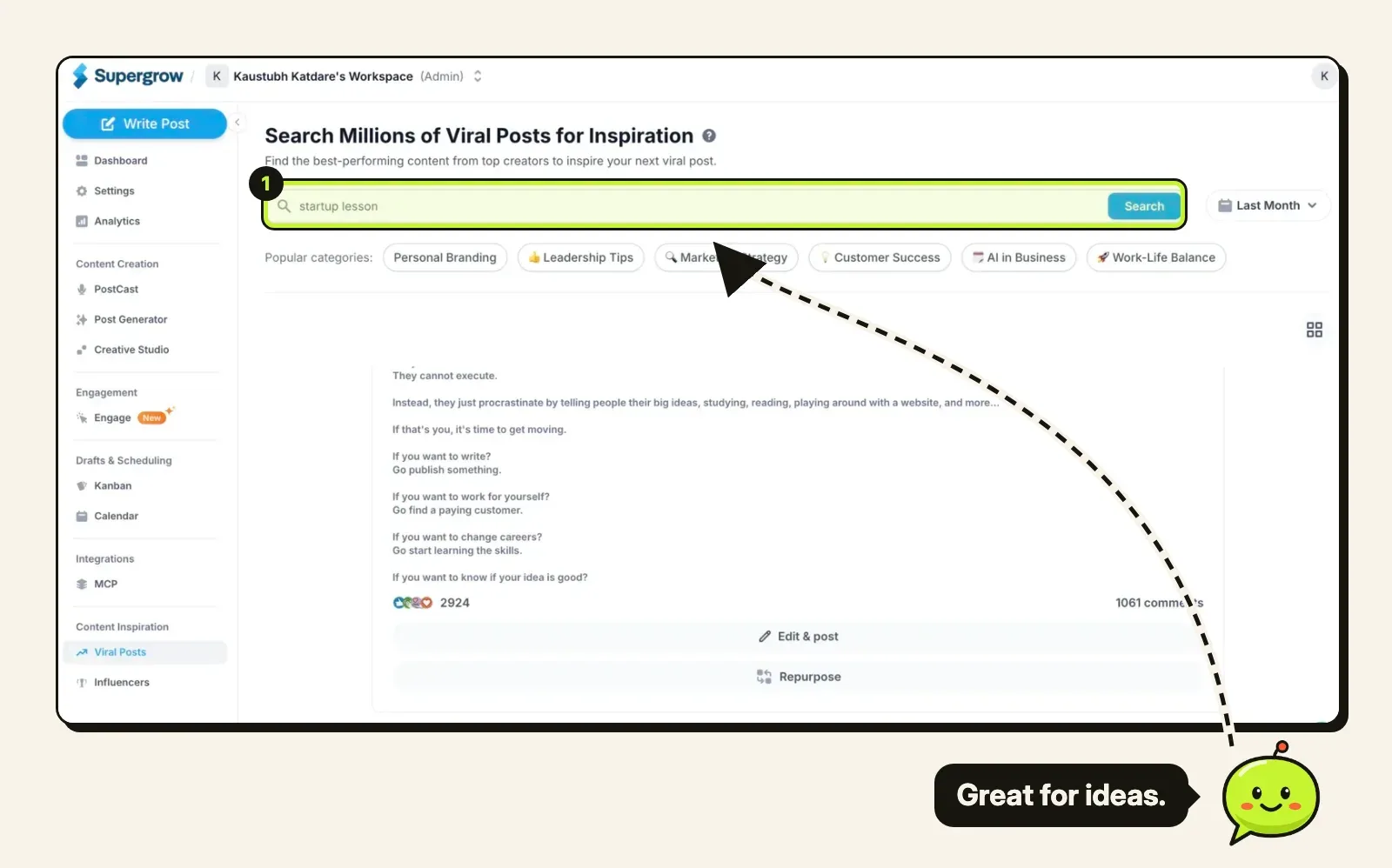
The Viral Posts search pulls up recent popular posts for any term. I searched "startup lesson" and found good examples to learn from.
And it connects to LinkedIn through LinkedIn's own sign-in. No browser extension.
Cancelling
This one surprised me. I deleted my workspace, Supergrow logged me out, and I assumed I was done.
I wasn't. When I logged back in, the trial was still running.
So I went to Payments and cancelled the subscription. It asked for one reason (I said I was switching to a new tool) and let me go. No offer, no hoops. The cancel itself was super simple, once I found the right place.
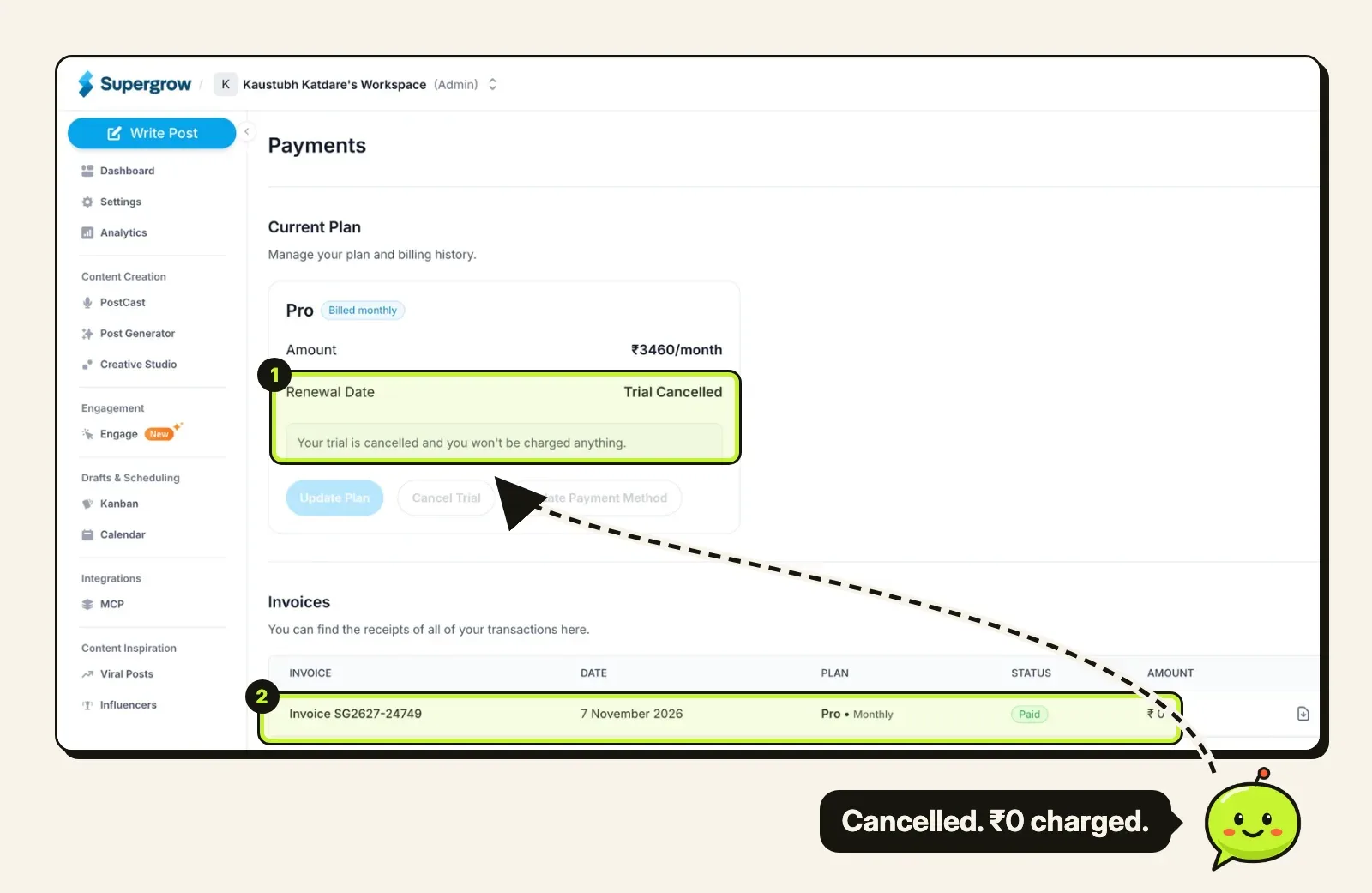
The invoice says ₹0.00, so nothing was charged.
Who it's for
People who'd rather talk than type and will sit through the full interview. Teams that need approvals and a shared calendar. If that's you, it's worth a look.
For me, the issue was effort. I had to do the work: sit through the interview, rebuild posts around hooks, rewrite what didn't sound like me. I want a tool that learns as I go and starts from whatever's on my mind. That's why I built Wiral, and why the weekend line above came from my own life as a founder. If that's you too, here's how Wiral works for founders.
If you're looking around, I've put six Supergrow alternatives side by side, with prices, trials and which ones ask for a card. And if you're weighing it against Taplio, here's Taplio vs Supergrow.
Have you tried Supergrow, or any AI interview tool? Did talking it out work better for you than typing? I'd love to know in the comments.